Federal Standards, Rights, and Accountability Agency
Proposed / Draft
The Moderate Party of America supports creation of the Federal Standards, Rights, and Accountability Agency, or FSRAA, for federal matters. This policy also calls for each state, through its own state law, to establish an independent State Standards, Rights, and Accountability Agency, or SRAA, for state and local matters.
No profession, company, police department, government body, or connected organization should control the investigation of its own alleged misconduct. FSRAA will provide one independent federal system for federal matters. Each SRAA will provide the corresponding independent system for state and local matters. Together, and only within their respective lawful jurisdictions, they will investigate violations of constitutional rights, professional standards, consumer protections, public integrity, financial accountability, health and product safety, privacy, and critical systems.
The federal and state agencies will use civilian investigators, written findings, independent appeals, enforceable deadlines, and meaningful outcomes. Suspected crimes will be referred to an independent prosecutor with jurisdiction. Courts, not agency investigators, will decide criminal guilt and punishment.
FSRAA will not supervise purely state matters or operate as a general appeals court over state decisions. Each SRAA will handle state and local matters, but federal jurisdiction remains available when conduct violates federal law, infringes a federal constitutional right, involves federal money or authority, or presents an interstate, multistate, or national matter. At either level, no organization may investigate itself, its friends, or a cooperating organization with which it has a conflict.
Purpose
FSRAA and each SRAA will, within their respective jurisdictions:
Provide one identifiable place to file covered complaints.
Conduct independent and impartial investigations.
Prevent police, agencies, professions, businesses, and connected organizations from investigating themselves.
Ensure investigations produce a written decision, correction, enforcement action, referral, or written explanation for closure.
Protect complainants and accused parties through evidence based decisions, due process, independent appeals, and court review.
Ensure responsibility and punishment are assigned to the people and organizations actually responsible.
Federal and State Jurisdiction
FSRAA may investigate violations of applicable federal law, federal constitutional rights, or federally established standards involving, but not limited to:
Federal officials, employees, agencies, and public bodies.
State or local officials, law enforcement, corrections, security, or other public safety personnel when the alleged conduct violates federal law or a federal constitutional right, obstructs federal authority, or involves federal money or programs.
Federal contractors and businesses, employers, landlords, insurers, service providers, licensed professionals, and regulated occupations subject to the applicable federal protection or standard.
Interstate, multistate, national, and cross-border misconduct.
Medical, veterinary, product, environmental, technological, privacy, cybersecurity, and critical-infrastructure matters governed by federal law or national standards.
Corporate misconduct, federal public funds, federal procurement, and federal financial accountability.
Rights and protections belonging to servicemembers, veterans, National Guard members, reservists, military spouses, and qualifying dependents.
Each SRAA may investigate violations of state law, state constitutional rights, or state standards involving, but not limited to:
State and local officials, employees, agencies, and public bodies.
State and local law enforcement, corrections, security, and other public safety personnel.
Businesses, employers, landlords, insurers, contractors, service providers, licensed professionals, and regulated occupations subject to state law.
State and local consumer, housing, employment, professional, medical, veterinary, product, environmental, privacy, and public-safety matters.
State and local public money, procurement, audits, contracts, and financial accountability.
A state or local title does not shield anyone from FSRAA when a federal right or federal law is involved. Likewise, FSRAA may not take control of a purely state matter merely because someone disagrees with the state outcome.
Neither level replaces ordinary courts, prosecutors, professional licensing bodies, or existing regulators. Each provides an independent investigative and enforcement system only when the matter falls within its lawful jurisdiction.
Agency Structure
FSRAA will have one central complaint intake process and five subject departments. Each state will establish an SRAA with the same five core functions. A state may combine smaller administrative units when appropriate, but it may not eliminate a function, weaken investigator independence, or avoid the deadlines, appeals, safeguards, or outside-review requirements in this policy.
At both levels, agency wide independent appeals officials, Enforcement Counsel, and an Inspector General will perform the separate functions described in this policy. The department descriptions below apply at the federal or state level only to the extent of that agency's jurisdiction. The dedicated Military, Veteran, and Servicemember Rights Division remains within FSRAA because the protections listed below are primarily federal.
Rights and Public Integrity
Investigates constitutional and civil rights violations, abuse of public authority, unlawful detention, professional misconduct by public officials, law enforcement misconduct, corrections misconduct, and related public integrity matters.
It may investigate unlawful conduct by judges or court personnel, but it may not substitute itself for an appellate court or punish someone merely because it disagrees with a lawful judicial decision.
Military, Veteran, and Servicemember Rights Division
The Rights and Public Integrity Department will maintain a dedicated Military, Veteran, and Servicemember Rights Division. It may form joint investigative teams with the Consumer and Professional Standards Department when a case involves employment, lending, insurance, housing, contracts, licensing, or paid services.
The division will investigate and enforce applicable protections involving:
The Uniformed Services Employment and Reemployment Rights Act, including employment, reemployment, seniority, benefits, promotions, pensions, and retaliation involving active duty members, veterans, National Guard members, and reservists.
The Servicemembers Civil Relief Act, including foreclosures, repossessions, leases, evictions, interest rates, default judgments, insurance, professional license portability, and other civil protections connected to military service.
The Military Lending Act, including unlawful interest, lending terms, mandatory allotments, forced arbitration, prepayment penalties, and other prohibited lending practices affecting servicemembers and covered dependents.
The Uniformed and Overseas Citizens Absentee Voting Act, including voting registration, ballot access, ballot delivery, ballot tracking, and counting protections for uniformed servicemembers, their families, and eligible overseas citizens.
Military family leave, including qualifying exigency leave and military caregiver protections under the Family and Medical Leave Act.
The Vietnam Era Veterans' Readjustment Assistance Act where its statutory protected veteran and covered federal contractor requirements apply.
Federal veterans' preference and related federal employment protections where the person and position qualify under the governing law.
Military whistleblower and retaliation protections for protected reports of illegality, fraud, waste, abuse, safety failures, or other protected disclosures, subject to the constitutional and statutory rules governing the Armed Forces.
Any successor or comparable federal protection for servicemembers, veterans, Guard members, reservists, military spouses, or qualifying dependents.
FSRAA authority must be coordinated by Congress with agencies that currently administer these laws. Existing private rights, stronger remedies, and lawful enforcement options must be preserved rather than replaced.
Consumer and Professional Standards
Investigates paid service failures, intentional misrepresentation, insurance misconduct, housing and rental violations, employment standards, dishonest professional practices, and violations by licensed or regulated service providers.
Corporate and Public Funds
Investigates corporate misconduct, financial fraud, misuse or theft of public money, failed audits, procurement violations, improper transfers between dedicated funds, and systemic business practices that violate federal standards.
Health, Product, and Environmental Safety
Investigates improper medical or insurance denials, unsafe products, veterinary safety violations, environmental violations, public health matters, and conduct that creates an unreasonable danger to people, animals, or communities.
Technology, Privacy, and Critical Systems
Investigates privacy violations, misuse of personal information, unlawful surveillance pricing, discriminatory algorithms, cybersecurity failures, digital market access violations, and threats to critical infrastructure or essential technological systems.
Independent Investigations
Covered organizations may not investigate themselves. This prohibition applies to FSRAA, every SRAA, and every organization subject to their jurisdiction.
An investigation may not be controlled by:
The organization accused of misconduct.
A current coworker, supervisor, subordinate, close associate, or personal friend of an accused person.
A neighboring or cooperating department that regularly exchanges internal investigations with the accused organization.
A professional organization whose members have a direct conflict of interest in the outcome.
Subject matter experts may assist investigators, but they may not control the investigation when they have a personal, professional, financial, or organizational conflict.
Investigators must disclose conflicts and be removed from a case when their independence could reasonably be questioned.
Complaint and Investigation Process
Every covered matter follows the same process within the responsible federal or state agency:
Central complaint intake: The complaint is recorded, acknowledged, and assigned a case number.
Department assignment: The matter is sent to the department with the appropriate expertise. Related departments and the appropriate federal or state agency may cooperate without requiring the complainant to file multiple complaints.
Civilian investigation: Investigators collect evidence, interview relevant parties, examine applicable standards, and provide the accused party a meaningful opportunity to respond.
Decision and appeal: The agency issues an initial written decision. Either affected party may request an independent appeal conducted by officials who did not participate in the original investigation. A final written agency decision must follow.
Every decision must explain:
What was alleged.
What evidence was considered.
What facts were established.
Which law or standard applies.
Who was responsible.
What corrective action, penalty, referral, or closure results.
How an appeal or court review may be requested.
One Complaint Standard
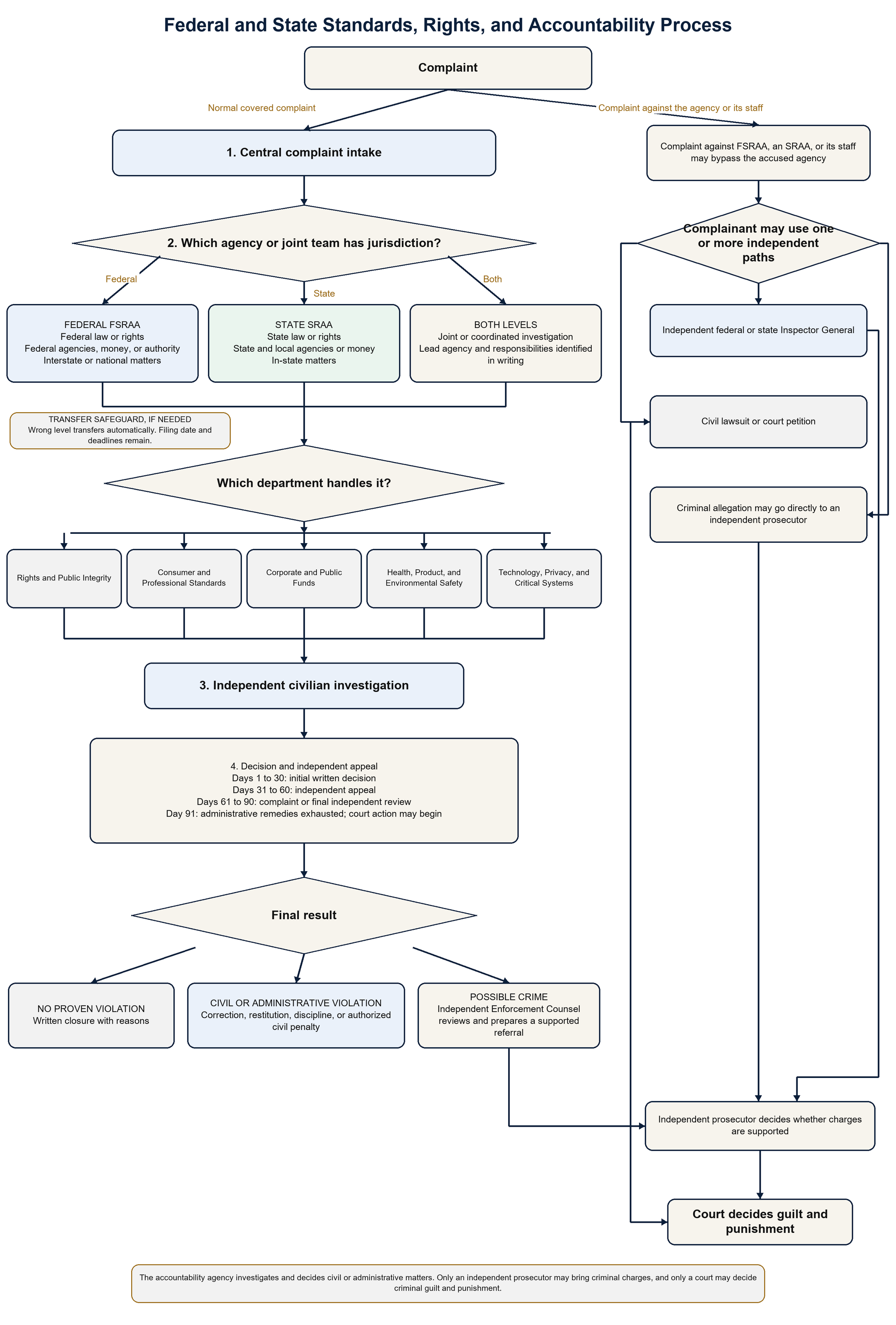
Flowchart showing federal FSRAA and state SRAA complaint routing, joint investigations, transfer safeguards, five core departments, independent appeals, remedies, criminal referrals, and outside review.
A protected person will not be required to determine which federal agency, state agency, department, or level of government has jurisdiction before seeking help.
FSRAA or the SRAA receiving the complaint must:
Accept and record the complaint.
Identify every applicable protection.
Coordinate with the appropriate federal or state agency and existing enforcement bodies without forcing the complainant to restart the process.
Preserve the original filing date.
Maintain responsibility for tracking the matter until a written outcome or lawful referral occurs.
If a complaint must be transferred, document the reason, receiving office, responsible official, and remaining deadline. A transfer may not restart the filing date or administrative deadlines.
The 30/30/30 Standard
An initial written decision must be issued within 30 calendar days.
An independent appeal must be decided within the next 30 calendar days by a decision maker who did not make the original decision.
Any complaint or final independent review must be completed within the following 30 calendar days.
On day 91, administrative remedies are exhausted and court action may begin.
The clock may not be restarted by transferring, reclassifying, reassigning, renaming, or reopening the matter, by requesting information the government or organization already possesses, or by making immaterial repeated requests.
These deadlines govern the administrative process. They do not control the later timetable of an independent prosecutor or court.
Emergency Protection
Immediate court access remains available when delay may cause irreparable harm.
When delay could cause foreclosure, eviction, repossession, job loss, license loss, a missed election, loss of health coverage, destruction of evidence, or another harm that cannot reasonably be repaired later, the responsible federal or state agency must immediately seek or facilitate a temporary stay, injunction, preservation order, or other authorized emergency relief.
The 30/30/30 process is the maximum administrative timetable, not a reason to delay urgent protection.
Findings and Responsibility
Liability must follow responsibility.
Every decision must separately determine whether the violation was:
Individual misconduct.
Supervisory or management negligence.
Organizational misconduct.
A systemic policy or practice.
Shared misconduct involving more than one responsible party.
Ownership, employment, or job title alone does not establish personal guilt.
An organization may be held responsible when the evidence establishes that the violation resulted from its policy, algorithm, quota, incentive, management decision, reckless hiring or supervision, repeated failure after notice, concealment, or knowing tolerance of misconduct.
An isolated employee violation does not automatically become a systemic violation by the organization. The organization may still be required to compensate an injured person when the governing law makes it responsible for harm caused through its operations.
Outcomes and Enforcement
If no violation is proven, the agency must issue a written closure explaining why.
If a civil or administrative violation is proven, the agency may impose or seek the correction, restitution, discipline, civil penalty, or other remedy authorized by the underlying policy or law.
FSRAA and the SRAAs do not create a single automatic penalty for every subject. Each underlying federal or state policy retains its approved penalty schedule based on the conduct, harm, intent, repetition, and responsible party.
For military, veteran, and servicemember rights, FSRAA may order or seek every remedy authorized by the governing law, including reemployment, reinstatement, back pay, lost benefits, restored seniority, restored promotions, leave and pension credit, correction of records, return of unlawfully collected money, restoration of housing, property, licenses, insurance, or other protected interests, injunctive relief, statutory damages, civil penalties, attorney fees, court costs, and individual or organizational discipline.
Retaliation, deliberate delay, destruction or falsification of records, concealment, and knowingly giving false information during an investigation constitute separate violations when proven under the governing law.
Criminal Referrals
If the evidence indicates a possible crime:
Agency investigators complete the factual record.
Independent Enforcement Counsel reviews the record and applicable law.
Enforcement Counsel refers supported criminal matters to an independent prosecutor.
The independent prosecutor decides whether charges are legally supported.
A court decides guilt and punishment.
Agency investigators may not declare someone criminally guilty.
Criminal liability for the administrative process must target intentional misconduct such as knowing falsification, destruction of evidence, obstruction, retaliation, bribery, deliberate rights violations, or intentional delay intended to injure or coerce. An ordinary mistake or missed deadline by itself is not a crime.
Independent Appeals and Court Review
An appeal must be decided by officials who did not investigate, supervise, approve, or participate in the original decision.
After the final agency decision, either affected party may seek judicial review when permitted by law. The agency must provide the complete case record to the reviewing court.
For authorized civil enforcement, Enforcement Counsel may file the action in court or refer it to the Department of Justice or the appropriate state attorney general.
Complaints Against FSRAA or an SRAA
A complaint against FSRAA, an SRAA, or their investigators, leadership, or staff may bypass the accused agency's normal complaint process.
The complainant may use one or more of the following:
The appropriate independent federal or state Inspector General.
An independent prosecutor when criminal conduct is alleged.
A civil lawsuit or court petition.
Any other lawful external oversight process.
The Inspector General may refer evidence directly to an independent prosecutor or the appropriate court. No official of the accused agency may direct, limit, delay, or participate in that investigation.
When a complaint against an SRAA presents a federal constitutional or statutory issue, it may also be filed with FSRAA. FSRAA may not review a purely state claim merely because the complainant is dissatisfied with the state result.
Federal and State Coordination
FSRAA and the appropriate SRAA may conduct a joint investigation when the same conduct presents both federal and state issues. The agencies must identify a lead agency, divide responsibilities in writing, share records only as permitted by law, protect privileged and personal information, and preserve every filing date and deadline.
If a complaint is filed at the wrong level, the receiving agency must record it, preserve the original filing date, explain the transfer in writing, and send it to the proper agency. Transfer may not restart the 30/30/30 clock.
Federal review is available only when there is a federal basis, including:
A federal constitutional or statutory right.
Federal officials, agencies, money, programs, contracts, or authority.
Interstate, multistate, cross-border, or national conduct.
Obstruction of a lawful federal investigation or remedy.
A state conflict of interest affecting a matter that independently falls within federal jurisdiction.
An SRAA is responsible for purely state and local matters. Its system must meet the MPA standards for:
Investigator independence.
Conflict disclosure and removal.
Due process.
Written findings.
Appeals.
Deadlines.
Evidence preservation.
Appropriate enforcement or referral.
External investigation of complaints against the SRAA itself.
A state investigation does not prevent federal review when a federal right or federal standard is involved. A federal investigation does not prevent lawful state review of a separate state violation.
The agencies must coordinate restitution and financial recovery. A victim may be made whole, but may not receive duplicate repayment for the same loss. Separate federal and state penalties may still apply to separate violations, separate harms, or separate governmental interests.
Existing Rights Remain Available
Filing with FSRAA or an SRAA will not eliminate or improperly delay:
A private lawsuit.
An existing administrative complaint.
Assistance from military legal services.
Referral to the Department of Justice, Department of Labor, Office of Special Counsel, Consumer Financial Protection Bureau, or another authorized body.
Emergency relief from a court.
Any stronger state protection.
Where current law permits a private action without exhausting an administrative process, that right remains protected.
No Enforcement Quotas
No investigator, supervisor, department, contractor, or agency employee may receive compensation, promotion, discipline, or performance credit based on:
The number or value of fines imposed.
The number of people found responsible.
The number of criminal referrals or convictions.
The amount of revenue generated.
A requirement to find either guilt or innocence.
Performance must be evaluated through documented accuracy, professionalism, attendance, timeliness, completed work, lawful conduct, evidence quality, and compliance with agency standards.
Transparency and Auditing
FSRAA and each SRAA must publish aggregate reports showing:
Complaints received.
Assignment and completion times.
Findings and closures.
Penalties and corrective actions.
Criminal referrals.
Appeals and reversals.
Missed deadlines.
Complaints involving FSRAA or SRAA personnel.
Personal information, protected evidence, active criminal matters, and legitimate security information must be lawfully protected.
FSRAA and each SRAA must undergo regular independent financial, performance, civil rights, and case handling audits.
Constitutional Safeguards
FSRAA and each SRAA may not:
Conduct unlawful searches or seizures.
Punish protected speech, political activity, lawful protest, religion, association, or disagreement.
Presume guilt from an accusation.
Deny notice or a meaningful opportunity to respond.
Replace a prosecutor, judge, jury, or appellate court.
Use its authority to retaliate against complainants, witnesses, accused parties, attorneys, or journalists.
Exceed the authority granted by statute.
Compulsory records, subpoenas, warrants, and court orders must follow constitutional and judicial procedures.
Core MPA Standard
One federal agency for federal matters. One independent state agency in each state for state and local matters. Five core functions at each level. Independent civilian investigations. Written decisions. Real appeals. Real enforcement. No organization investigating itself, no government level exceeding its lawful jurisdiction, and no punishment without evidence and due process.
Status: Proposed / Draft, not yet formally adopted.
Originally published: October 4, 2026.
Last updated: October 4, 2026.
Version: Draft 0.3.